Breaking Up With Zion
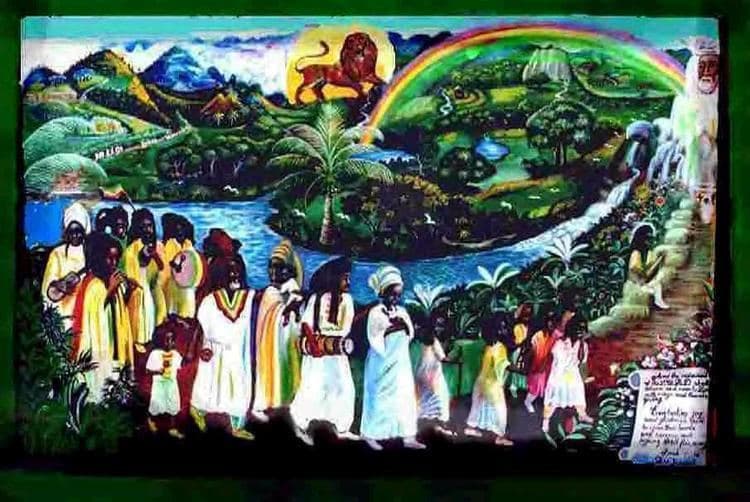
I used to feel at home in Rastafari. Not in the throne-room theology, but in the movement’s anti-colonial ethos, its culture of refusal, and the Ital livity. But over time, I had to step away. First quietly, and then came the deepest rupture, namely, the resurface of Zionist readings that conflate "Zion" the metaphor with "Zionism" the state project. Since October 7, 2023 – when Israel’s colonial assault on Palestine escalated into open genocide – those tensions have sharpened into a question I can no longer dodge: can Rastafari still be defended as a liberatory tradition?
We were never a perfect match
Even in my most Rasta-leaning years, scripture was never the hook for me. I did not believe in the idea of Haile Selassie as the incarnation of christ. Or a Christ at all. Perhaps I was never a real Rasta anyway. I mean, it is in the name: Ras Tafari.
What drew me instead was the politics. A counter-hegemonic tradition that read Babylon as empire and practiced everyday refusal as living critique through music, (non)consumption, style (in the nonconforming, anticapitalist and pro-Black sense), and community. Critical scholars have long described Rastafari in those terms: born out of resistance to colonial domination, forged in cultural opposition, and spread globally – across Africa and its diaspora – as both protest and countercultural lifestyle.
But countercultures rarely stay untouched once their power takes notice. States have ways of channeling radical traditions into safer forms, through surveillance, repression, or simply by amplifying the least threatening elements. In the case of Rastafari, its public image was shaped partly by an eccentric spiritual style, and internally, there seemed to be a push toward a more familiar Abrahamic religiosity. Both were easier for mainstream audiences to digest than Rastafari’s anti-imperial critique.
As Rastafari became legible to wider publics, its religious language was often amplified while its anti-colonial spirit was tamed. That matters to me personally, because I kept running up against the doctrinal edges that come with scripture-centered movements. Their rigid gender roles, heteronormative expectations, and outright homophobia. Thus, my belonging felt conditional. A Biblical gatekeeping makes it easy to police bodies, desires, and queer forms of kinship. And although I have known kind, open-minded Rastas, I have also been told that liberation ultimately has a heterosexual and family-oriented shape. I could simply not build a home there if I wanted to live an authentic life.
A messy entanglement
Rastafari’s relationship with the Bible is complicated. The same text that colonizers used to sanctify colonial conquest also gave the colonized a grammar of reversal, where Ethiopia stood over Babylon, and the last would be first. That dialectic created brilliant political poetics, but it also left a back door for colonial rhetoric to walk back in. When the Bible is allowed to set the whole frame, "Zion" can shift from a Black diasporic horizon (Africa, Ethiopia, return) into a de-historicized endorsement of modern Zionism.
Since October 7, my stomach turns hearing reggae chants of "Zion". I can no longer divorce them from the ideology responsible for the colonization and ethnic cleansing of Palestine. Indeed, Israel has long had a vibrant reggae scene, as have many countries world-wide, but Israel’s "One Love" birthday festivals, big-name bookings, and steady celebration of reggae's "Zion" as self-evidently Israel is too messy of a history well-documented in local culture pages and event listings going back decades.
Meanwhile, major figures tied to the Marley legacy have openly aligned with pro-Israel initiatives. In October 2023, Ziggy Marley signed Creative Community for Peace’s letter backing Israel. It was a letter condemning "tragic acts of Hamas" and urging solidarity with Israel without naming Palestinian colonial suffering. He also attended the Friends of the IDF Gala in Los Angeles in 2018. The event raised roughly $60 million that night, as reported by mainstream outlets; celebrity attendee lists include his name. (Attendance at a fundraiser isn’t the same as writing a check, but the optics are the point).
This is where the Biblical slide shows its teeth. When "Zion" is allowed to name a modern nation-state, reggae’s anti-colonial grammar gets flipped. The colonized become aggressors, and the colonizer becomes "David." The dissonance is unbearable if you overstand Rastafari's anti-colonial ethic.
But Zion was never Jerusalem
Of course, many Rastas insist "Zion" names Ethiopia/Africa and a moral order, not the State of Israel, and some contemporary Rasta voices are unequivocally anti-colonial and pro-Palestinian. You can hear that in community writing and reasoning that calls out censorship and repression around Palestine, and tries to return the tradition to its decolonial center. I honor such efforts, but movements are judged, fairly or not, by the meanings that win in public. And the public has spoken.
Let’s all agree that Marley opened the gates. His reggae carried Rastafari out of Jamaica’s margins and into white, wealthy markets. With that came visibility, money, and a new audience eager for "One Love" (hypotethically, of course. Palestinians are not included). Once a culture of resistance reads as cool, institutions will platform the parts they can digest (spirit, style) and mute the parts that cost them (political resistance and refusal). And in the very particular case of Israel, it is precisely the biblical lines that garnered interest.
I hold onto the livity. The emphasis on ital food, embodied discipline, anti-colonial ethics, and communal care remains one of the movement’s most subversive gifts. It is a daily, material refusal of imperial consumption that taught me how to live with less and love with more. I also keep the analytical lens of Babylon as empire. That reading lives in the scholarship and in the best of the culture, not just in my nostalgia.
What I refuse, though, is any liberation that needs me straight to count. But also, the slide from metaphor to mandate. The move that turns "Zion" into a pass for state violence and genocide, or that treats the Bible as a trump card over anti-colonial ethics. I refuse the brand that markets "One Love" to white audiences while the politics that birthed it are backgrounded or misinterpreted. No matter how much the livity still shapes me, The politics that mattered most now require me to step away forever.