Coronavirus, it's real. And so is white privilege.
Last year, Brussels recorded three deaths caused by police cars. Three. This weekend marked the first of 2020. No research has yet examined these "accidents," but they share a grim pattern: the victims are always young men of color, often Muslim. These deaths are not the kind of police violence that draws headlines, because there are no beatings, no attacks by dogs, no sexualized torture. Only death.
The strict Covid-19 measures in Belgium have created a hostile climate. Protests for human rights and dignity are dismissed as riots, and expressions of grief and anger are reduced to disturbances. Inequalities are deepened, as some can retreat to spacious homes with balconies, while others remain confined in crowded, unsafe conditions with no privacy or escape. Meanwhile, online spaces have become the primary forum for social justice, with activists scrutinizing structural racism, sexism, classism, and nationalism while in lockdown.
I had taken a break from this world, retreating into my apartment (with balcony) to focus on myself after burnout. I felt blessed. Until I opened up Facebook, reading about yet another young man dead under a police car. How could this happen again? Why now? He had run from the police, they said. And once again, that was enough to justify his death in the eyes of the system. Also, he was Moroccan.
The public narrative ignores the structural violence that shapes these deaths. News articles focus on property damage, framing young people as rioters rather than individuals enraged by repeated systemic violence. It had only become clearer that the lockdown leaves some communities even more vulnerable, with little room for grief and no room at all for justice.
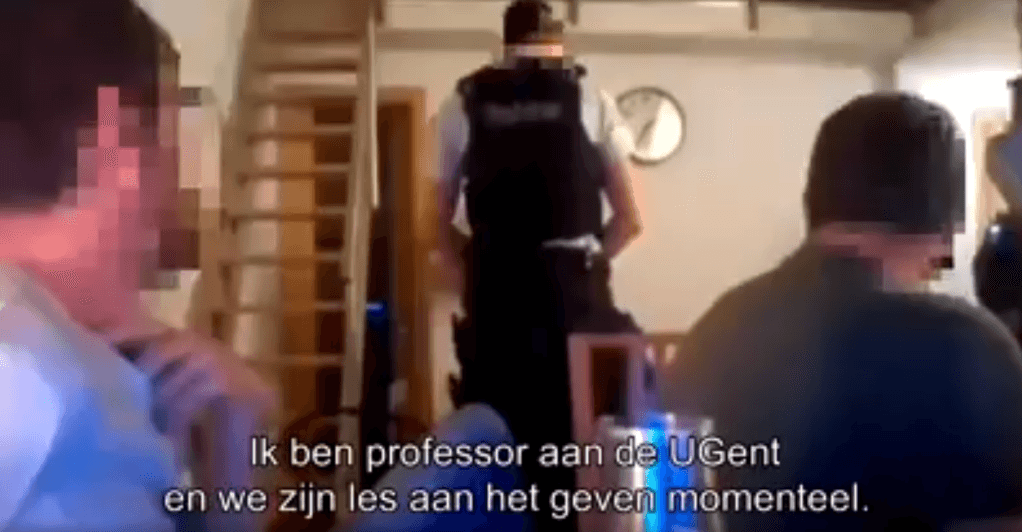
That same night, two colleagues of mine at Ghent University faced a very different encounter with the police. A professor and his assistant, together in the same apartment, had organized an online social gathering for their students. Supposedly to support their mental health in times of social confinement. Their livestream turned into something rather informal, included alcohol and racial slurs (nigger, nikker, neger), until eventually it drew a noise complaint. When the police arrived at the address of the professor, a bizarre confrontation unfolded where the professors - insisting on their academic titles - drew comparisons between the Nazi regime and the way the police (as an extension of the state) handled their social gathering. They felt stripped of their rights (hence the Nazi comparison. I mean, damn,) and therefore refused to identify themselves. Mind you, this was all livestreamed.
Eventually, the officers left. The livestream went viral and the professor's teaching privileges were suspended pending review. The contrast of that evening in Ghent versus Brussels is sharp. Their issue was how the lockdown forbid them, temporarily, to be together in the same space, while for many young people in dense, disadvantaged neighborhoods, there is a lack of room to breathe, alone or with peers.
This weekend revealed how privilege works. Two white men, occupying positions of extreme privilege, faced procedural consequences. (Update: they ultimately did not face court proceedings and carried on with their lives, albeit away from Ghent University). Above all, they remained alive, unharmed, their lives minimally disrupted. I'm sure everyone will have forgotten about this by next year. Meanwhile, a nineteen-year-old lost his life. He was punished for leaving his house, for not complying to the social distancing regulations, for existing as a young man of color in Brussels, Belgium. It shows how structural inequality is not abstract, but literal and deadly.
#JusticePourAdil