The messy politics of #homesteadcore
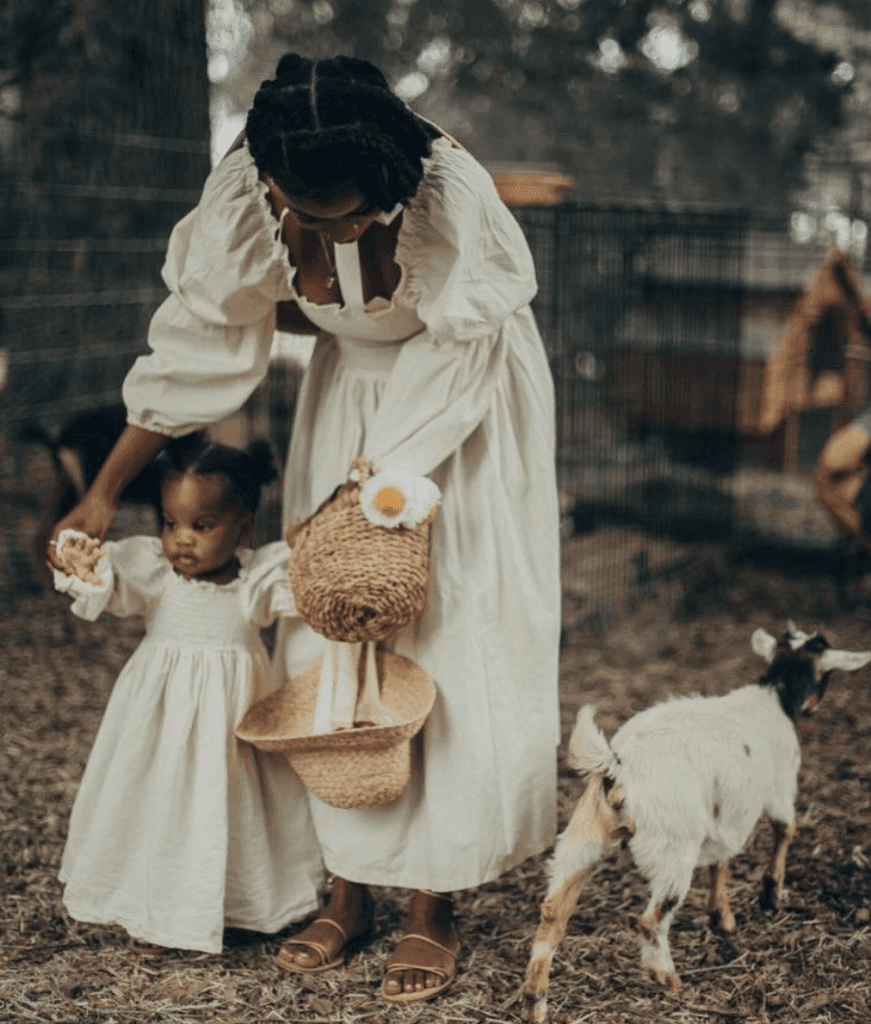
Homesteadcore is one of the many "cores" that have flourished online in recent years. At its heart lies a fascination with self-sufficiency and domestic life. "It’s what happens when a generation that can’t rely on housing, healthcare, climate or even the grocery store decides to turn survival into an aesthetic," writes purewow author Sydney Meister. Images of cabins and farms, mason jars with pickled veggies from the garden, woodpiles and raised beds, lumberjacks and linnen circulate widely on TikTok, Instagram and YouTube as part of a larger wave of aesthetic trends. Sometimes, the focus is on the labor of off-grid living, like in Wild Wonderful Off-Grid. But in many cases, it’s the idyllic aesthetic that draws people in, like in Roaming Wild Rosie’s solo renovations in rural Sweden or Gaz Oakley’s perfect avant-garde vegan cottage lifestyle in Wales. Sometimes, the aesthetic is everything. It’s when homesteading becomes cottagecore, which centers the hyper-romantic and feminized depictions of rural life, often captured through dreamy cinematic imagery. It’s where the floral dresses and handwoven baskets come in. I'm thinking of Isabel Paige’s musings of life in the mountains of Washington, and Jonna Jinton's enchanting life in the woods of northern Sweden.
But what is a homestead, really? According to the Collins dictionary, a homestead - in North American English - historically refers to a settlement: an area of land (usually 160 acres) granted to a settler (i.e. colonizer) as a home. This definition paints a picture of what homesteadcore may allude to. But in its most basic sense, a homestead is a house owned by a (nuclear) family, often including a farmhouse, with land devoted to crops or animals.
One of the most controversial examples of homesteadcore is Hannah Neeleman’s Ballerina Farm. The Juilliard-trained ballerina turned Utah farmer shares a vision of rural life centered on family, dairy (iykyk), and homemade meals. Her brand merges artisanal farming with polished lifestyle marketing. She is not exactly worried about housing, healthcare or groceries. Not only because all that is provided by her billionaire husband, but because - like many other women in her "field" - she has built an empire on the aesthetic of homesteading on social media.
At the age of 34, she is a mother of eight biological children. Because of that, in combination with her faith, homesteading, and family-oriented lifestyle, she is often associated with the "tradwife" phenomenon. Following the ideal of "traditional" house wifery, the tradwife is a (young) woman, married early, raising multiple children, devoted to home-cooked meals and farm-to-table routines. Online she appears in crisp linnen or vintage dresses, with sourdough bubbling on the counter and a baby on her hip. The labor of domestic life is paired with the aesthetic of rustic calm.
The extra tricky part: the tradwife is openly embraced in right-wing communities, because she is conservative and christian. She is held up as proof that feminism has failed and that "deep down, women don't really want to work." She embodies submission as salvation, a return to patriarchal order as divine truth. In this vein, homesteadcore depicts not just a lifestyle and an aesthetic, but a political vision.
But what happens if this lifestyle (and the aesthetics of it) is sought after by women who are pro-choice, queer-affirming, racially minoritized, non-religious, and/or deeply critical of the political right? This is where the messy entanglements of aesthetics and politics in #homesteadcore become visible. The paradox of what I call progressive homesteaders forces us to ask why certain forms of domesticity and rural life are increasingly desired, even among progressives, and why, perhaps, we must stop reading them as inherently white and conservative. I cannot think about this without recalling an acquaintance of mine: a young woman of mixed Belgian and East African heritage with a style and mind of her own. She moved through antiracist and Black cultural circles, and eventually settled with a (white) guy with whom she moved relatively fast. They had two children, one right after the other, while both in their 20s. They remind me of Nara and Lucky Blue Smith. Or, actually, the Smiths remind me of them. Except, my acquaintance's politics are unmistakably progressive, whereas Nara is known for cosplaying 1950s housewifery for a living.
When I visited them after the birth of their second baby, they spoke of leaving the city and moving into a farmhouse in the Flemish countryside. She had stepped back from activism and was no longer vegan. These changes startled me at first. They felt like echoes of the cultural shift I was seeing online, but refracted through different politics. Or perhaps it was just coincidence. In any case, the resemblance to the homesteading aesthetic was close enough to notice.
The tradwife’s return to "tradition" (in terms of food and family, no matter how recent the history of the nuclear family actually is) is an explicit rejection of feminism, queer liberation, veganism, and cosmopolitan pluralism. Yet family-centered and land-based living has also been claimed by progressive movements. In the 1970s, back-to-the-land hippies imagined communes as an alternative to capitalist urban life. Black cooperative farms dating back to the slavery era sought autonomy and survival in the face of systemic exclusion. It happens in Belgium as we speak, through the POC-centered Back 2 Soil Basics collective. Or in France, with Jah Jah Hiking Club. They both embrace a pro-Black and ecofeminist ethos, linking care for the earth with care for each other. Clearly, the rural aesthetic has always been politically malleable. What looks like nostalgia for patriarchal order in one setting can represent resistance to consumerism, racial capitalism, or ecological collapse in another.
For people of color, the countryside has long been associated with exclusion and surveillance, while the city promised refuge. To choose rural life as a Black person in a predominately white environment is therefore never just aesthetic. It can be survival (of economic pressures), refusal (of dominant scripts), and posibility (of new ways of living). And what if capturing it (for social media) can serve as a mode of survival too? (since we're witnessing). To choose "domestic" life, on the other hand, is... something else.
Recently, I stumbled upon a new channel. Clélia moved with her family, her siblings' families and her mom from the city to a farm in the Flemish countryside. She is not performing the labor of self-sufficiency so much as embodying what it means for a Black family to take up rural space in Belgium. I do not necessarily believe this move was politically motivated, but rather practically, a way to really live together. No matter what, it is striking and bold in its own right. And the speed with which her channel blew up shows the depth of our collective desire for rest, community, and rootedness away from the city.
So, what to do with #homesteadcore? These homestead images circulate widely because they hold out a promise. A promise of something slower and more rooted than the exhaustion of life in times that are hostile, expensive, genocidal, and simply frightening. "Progressive homesteaders" - if you will - show how fragile the political binaries of left and right really are, especially when complicated by race, place, and history. They remind us that such categories were built around white experiences, that is, white hopes, dreams, and struggle. In the end, homesteadcore cannot always be dismissed as conservative nostalgia, nor claimed as progressive resistance. Instead, it forces us to ask not just what people watch or wear or eat, but what they are trying to build in a world that feels unliveable.