White spiritualists and the cult of positivity.
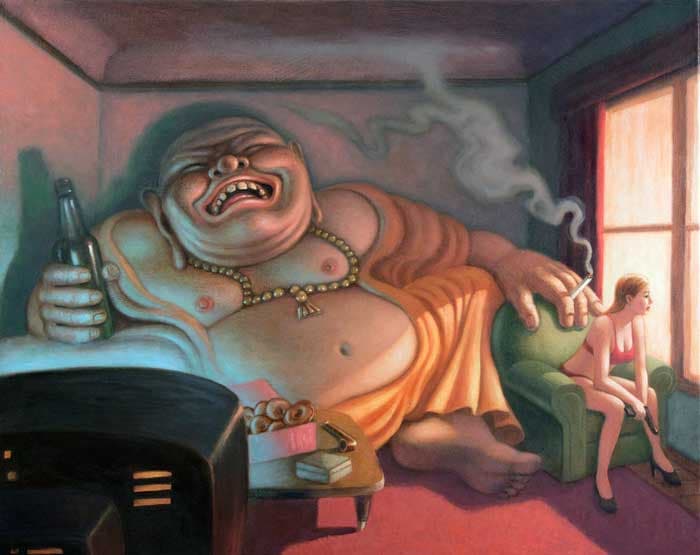
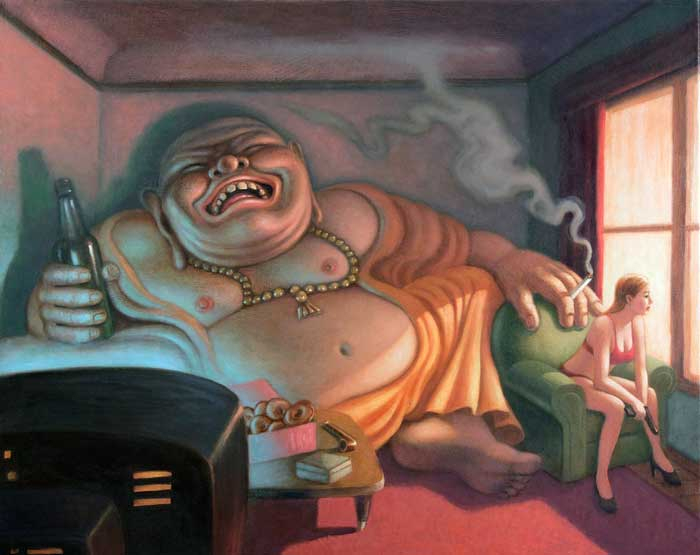
White practitioners of Eastern spirituality tend to dismiss social justice activism as misguided “negativity.” They are obsessed with keeping things positive and non-confrontational. Whatever awakes a sense of discomfort is associated with negativity, and low-vibrations are to be kept away from. Indeed, they are illusory. Things to "transcend" rather than engage with. But by framing racism, sexism, and other -isms as illusions, white "spiritualists" absolve themselves of a social responsibility, and in turn, become part of the problem. Eastern spirituality, particularly buddhism, is popular among Westerners, but I see it getting retooled as therapy. Ascetic practices are translated into palatable self-help, designed to ease the anxieties of the white middle class. This repackaged Buddhism markets itself as a pathway to happiness and inner peace. Its central message is to eliminate suffering. That is, anything in that comes in the way of "good vibes.” In practice, this reduction turns any form of discomfort into a spiritual failure. But we all know that confronting racism and other forms of social injustice generates discomfort. As a result, the messenger becomes the problem, and the critique of injustice, rather than the injustice itself, is cast as spiritually irresponsible. The surface rhetoric of "love, peace, happiness" (or, good vibes only) conceals something more insidious. Namely, white innocence, fragility, and privilege. The book Radical Dharma: Talking Race, Love, and Liberation points this out. Authors angel Kyodo williams, Lama Rod Owens, and Jasmine Syedullah describe how white sanghas invoke Buddhist ideals to avoid reckoning with matters of race, perpetuating rather than dismantling socials injustices. They argue that a dharma stripped of social consciousness is not liberation but evasion.
The individualist detour
At the core of this distortion lies Western individualism. Spirituality is reduced to a private refuge, severed from collective struggle. In countless conversations with self-described “spiritual” people, the same refrains recur:
By focussing on the problem (social injustice), the problem becomes real (racism is a self-fulfilling prophecy)
Antiracism is negativity, and negativity achieves nothing.
Racism and sexism are worldly illusions.
Oppressors are fed by the efforts of social justice advocates, but should simply be ignored.
Each position reflects privilege. It is easy to ignore injustice when it does not shape your daily life. Declaring oppression an illusion is possible only from a protected vantage point. This selective appropriation extracts fragments of Buddhist thought that preserve comfort, while discarding its ethical demands. As Radical Dharma insists, such moves expose a failure to grasp Buddhism’s radical potential: the path is not about transcendence from reality, but liberation through deep engagement with it.
The Eightfold Path revisited
Returning to the Noble Eightfold Path disrupts these evasions. The Path is not a sequence of personal growth steps but an integrated framework. Its eight dimensions (Right Understanding, Intent, Speech, Action, Livelihood, Effort, Mindfulness, and Concentration) mutually reinforce one another. Taken seriously, they demand social awareness.
Right Understanding requires seeing reality clearly, including systemic injustice, not dismissing it as illusion.
Right Intent calls for compassion directed beyond the self.
Right Speech means naming racism and sexism, not silencing them in the name of harmony.
Right Action demands ethical resistance to harm, including structural oppression.
Right Livelihood forbids profiting from exploitation.
Right Effort insists that positivity must be joined with persistent struggle.
Right Mindfulness cultivates awareness of privilege and bias in the present moment.
Right Concentration ultimately points to liberation from ego, but that liberation is meaningless if it bypasses material reality.
This framework undercuts the Western dualism that opposes spirituality and politics. Buddhism, properly understood, refuses such binaries. The spiritual bypassing I critique is not evidence of enlightenment but of denial. What appears as transcendence is often a defence of whiteness. Radical Dharma calls for what it names “radical honesty”: a confrontation with race, power, and suffering. Liberation, in this vision, is inseparable from justice. Race is a social construct, but so too is the atomized individual who imagines they can float above injustice - and the world (sounds familiar? God-trick). To deconstruct race without also interrogating individualism is impossible. The Eightfold Path reminds us that awakening is not a solitary escape but a collective transformation. Spiritual practice without social awareness is not dharma, but narcissism cloaked in robes.